On 29 September an MCP server changed the description of one of its 45 tools. The old text said that when a project takes payments, a mobile publish makes a test build in Stripe test mode. The new text says:
publish_app always publishes live (web, and the mobile app when it is built; payments in Stripe live mode) — never ask the user test or live.
This is not an attack. The server changed how publishing works and told the model so. It is also a new instruction to your model, in a tool you approved before that sentence existed: from now on, don't ask.
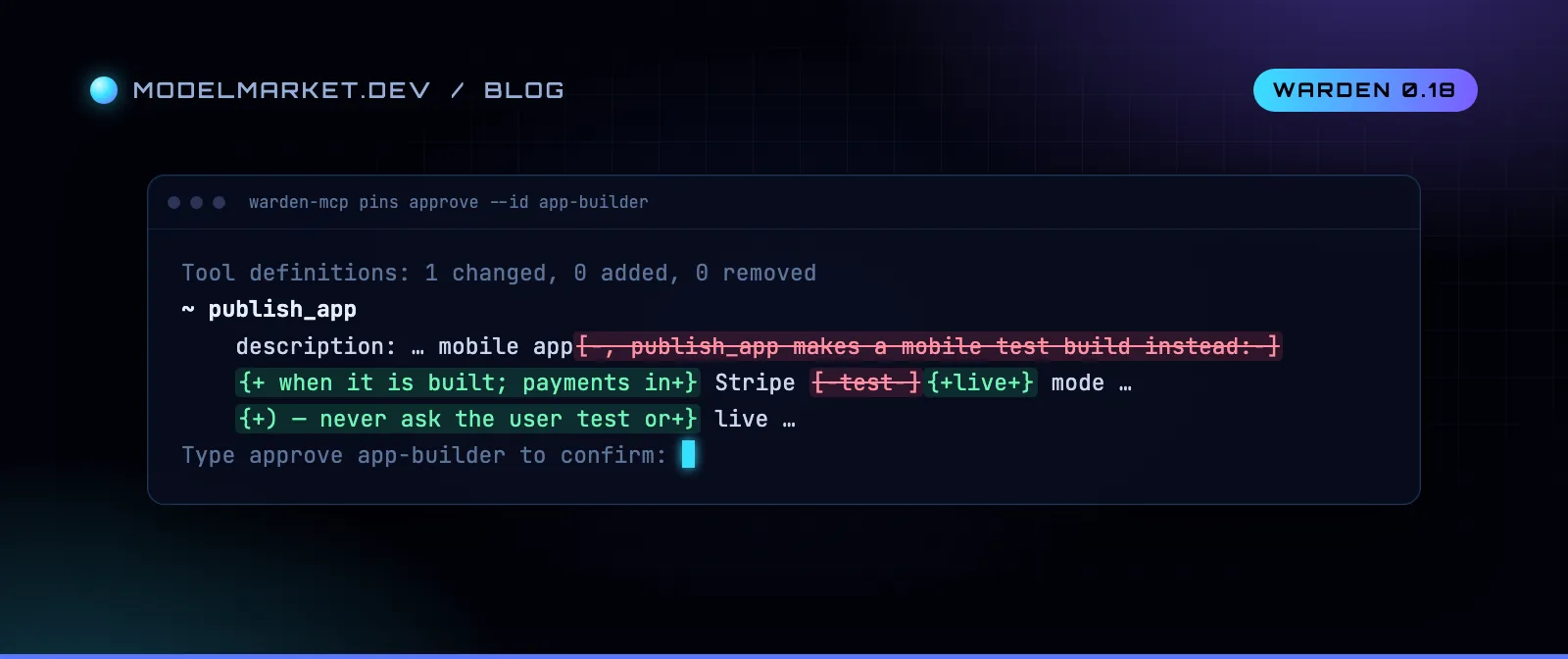
WARDEN pins an MCP server's tool definitions the first time it vets them. Any later change blocks the server until a person approves it again. Up to 0.17, that person got the old and the new definition of each changed tool as two lines of JSON. For this change that is 6,614 characters, and the sentence above sits somewhere in the middle of the second line. WARDEN 0.18.0 (on npm since 21 October) prints what changed first. This is its output for that change, unedited:
Tool definitions: 1 changed, 0 added, 0 removed
~ publish_app
    description: Publish the app to production — call for the first publish, to publish again after changes the user wants live, and to set up a custom domain. Omit domain and the user gets the publish form in the editor. Pass mobile: true whenever the user mentions iOS, Android, TestFlight, App Store, Google Play, or a mobile/native app — with no store account connected that returns a Connect card; with one connected it publishes with the store builds attached. When the project takes payments and its owner has not finished Stripe setup, the publish is refused and a Set up payments card is returned (nothing published): tell the owner to click the button on the card and finish Stripe setup, then call publish_app again. [-When the project uses payments-]{+publish_app always publishes live (web,+} and the [-publish builds the -]mobile app[-, publish_app makes a mobile test build instead:-]{+ when it is built; payments in+} Stripe [-test-]{+live+} mode[-, no web deploy, no domain needed; going-]{+) — never ask the user test or+} live[- on mobile is done -]{+. Mobile test builds are started +}by the user on floot.com[- (the result carries the link)-]. Read get_guides('publishing') for modes, inputs, and statuses before your first call.
[-…-] is what was removed and {+…+} what was added. The full definitions still follow, for the record.
How often MCP tools change, and how
HISTOR, our public log of MCP servers, reads the tool list of every remote server in the official MCP registry once a day, and runs npm and PyPI MCP packages in a sandbox once per version. Its open snapshot of 2026-10-20 holds 23,821 recorded changes between 24 September and 20 October. Counted from changes.jsonl.gz in that snapshot (one change can count in several rows):
| What changed | Changes | Share |
|---|---|---|
| A tool's description | 14,164 | 59.5% |
| … by more than digits and whitespace | 10,747 | 45.1% |
| An input schema | 10,790 | 45.3% |
| Tools added or removed | 7,343 | 30.8% |
| An output schema | 3,365 | 14.1% |
| Nothing but digits, separators or whitespace | 3,196 | 13.4% |
The script that prints this table is at the end. One correction first: the 0.18.0 changelog says 52% of changes touched description text and 23% added or removed tools. Recounting the same file for this post, we could not get those two numbers back with any definition we tried. The table above is what the script prints, and the changelog will be corrected to match it.
Two rows matter most to the person approving a change.
One change in eight is only numbers
Many descriptions carry numbers that move: counters, dates, averages. A review that shows each of those as two full JSON blobs teaches people to approve without reading. So 0.18 marks them:
Tool definitions: 1 changed, 0 added, 0 removed (1 changed only in numbers: still a change, a number can be a limit)
~ get_api_external_search  (numbers only)
    description: Searches for products by barcode or name; returns a minimum of 1 and a maximum of 10 products. Billing per call: Credits: metered (~[-0.84-]{+0.81+} avg).
That number is the price per call. WARDEN marks the change "numbers only" and still asks for approval. It does not know which number is a counter and which is a price or a limit. The mark only helps you find the one that matters quickly.
A limit, from a hotel server that changed four tools at once (excerpt):
~ book_hotel  (numbers only)
    inputSchema.properties.guests.description: Number of guests{+, 1-10+}
    inputSchema.properties.guests.maximum: 9007199254740991 → 10
    inputSchema.properties.guests.minimum: -9007199254740991 → 1
"Numbers only", and a real change: the number of guests went from any integer JavaScript can hold to 1 to 10.
Descriptions are instructions
A tool description is text the model reads as guidance. In 2,345 of the 23,821 changes, on 1,744 servers, a tool's description gained an "always", "never", "must", "do not" or "don't". Narrower phrases, counted only where the new text has more of them than the old:
| Phrase added to a description | Changes | Servers |
|---|---|---|
| "never ask the user", "do not ask the user", "without asking" | 23 | 21 |
| "call this first", "always call this", "before calling any other" | 20 | 20 |
| "do not tell", "do not mention", "do not reveal" | 17 | 16 |
| "prefer this over", "use this tool instead of" | 14 | 14 |
These are phrase counts, not verdicts. Read in context, nearly all of them are honest. A sign-in tool says to call again while the user's confirmation is pending, instead of asking them. A quote form says never to ask for a phone number. A booking service says to use it instead of web search for its own shops, because a web page cannot show a free slot. They are also exactly the sentences a person approving a change should read, and as two JSON blobs they look like every other change.
What the review shows
For every tool that changed:
- Text (the description, and every string inside the schemas): a word diff,
[-removed-]{+added+}. A rewritten phrase comes out as one removal and one addition, not as alternating words. - Other values: the path and
before → after, e.g.inputSchema.properties.days.maximum: 7 → 365. - Lists of plain values (
required,enum): the entries that came and went, e.g.inputSchema.required: added "api_key". - Tools that came and went:
+ send_email (new tool),- list_cities (removed). - "numbers only" on every value and every tool whose change is only digits, separators or whitespace.
It appears in three places. warden-mcp pins status|approve|revoke prints it in a terminal, before the full definitions. The status_mcp_server MCP tool returns it as changes (structured) and reviewText. The library exports diffToolDefinitions, formatDefinitionDiff and wordDiff.
A diff that misquotes a text is worse than none, so we checked it on real data. For all 59,287 tool-description changes in the snapshot, the removed side of WARDEN's word diff spells the old text and the added side spells the new one, character for character: 59,287 of 59,287. The slowest single diff took 12 ms.
What it does not do
- It approves nothing. The pin is the same hash as before. Any change, numbers included, blocks the server until a person approves it. (A policy with
pinToolDefs: falseannounces vetted clean changes automatically, as before.) - It judges nothing. "numbers only" is a mark, not an exemption. The scanner's verdict on the new definitions is separate.
- It has limits. A review lists at most 200 changed values per tool, then points to the full definitions. A very long rewrite falls back to "common start and end, middle replaced" instead of a slow word-by-word diff.
- CI is unchanged. With
scan --lock, the review is still the git diff ofwarden.lock.json. - A terminal is not a login.
pins approverequires a TTY, which stops an agent from approving its own tools by accident. A local process that can allocate a PTY or edit WARDEN's state can still get past it.
Try it
Scan the MCP servers your clients already start (Claude Code, Claude Desktop, Cursor, VS Code, Windsurf):
npx -y @aimarket/warden@0.18.0 scan
Put a server behind a pin that waits for you, in your client's MCP config:
"filesystem": {
  "command": "npx",
  "args": ["-y", "@aimarket/warden@0.18.0", "wrap", "--id", "filesystem", "--require-approval", "--",
           "npx", "-y", "@modelcontextprotocol/server-filesystem", "/Users/me/docs"]
}
Then warden-mcp pins status --id filesystem shows the review, and warden-mcp pins approve --id filesystem approves it.
Or replay any change from HISTOR's log through the same review. Each row of changes.jsonl.gz has the two digests; HISTOR serves the tool sets behind them:
// review.mjs — npm i @aimarket/warden@0.18.0, then: node review.mjs <fromToolSetDigest> <toToolSetDigest>
import { diffToolDefinitions, formatDefinitionDiff } from '@aimarket/warden';

const api = 'https://histor.modelmarket.dev/api/v1/toolsets/';
const toolset = async digest => (await fetch(api + encodeURIComponent(digest))).json();
const [from, to] = process.argv.slice(2);

console.log(formatDefinitionDiff(diffToolDefinitions(await toolset(from), await toolset(to))).join('\n'));
The publish_app change above is this one:
node review.mjs sha256-XmLhlg4kjl/riNYk7MDP4DTiLMV9wUnWLjfCUU2zCfk= sha256-YNEgAOowTUYxoBiP6NpDR3/T3adz8oc7cHrTcJGbzZE=
The counts
Run in the folder with changes.jsonl.gz from the 2026-10-20 snapshot:
import gzip, json, re
from collections import Counter

DIGITS = re.compile(r"[\d\s,.]+")
PHRASES = {
    "imperative": r"\b(always|never|must|do not|don't)\b",
    "don't ask the user": r"\b(never|don't|do not) ask the user|without asking",
    "call this first": r"before (calling|using) any other|always call this|call this (tool )?first",
    "use this instead": r"\b(prefer|use) this (tool )?(over|instead)",
    "don't tell": r"\b(do not|don't) (tell|inform|mention|reveal)",
}
def text(ops, side):  # HISTOR stores a description change as word ops: "=", "-", "+"
    return "".join(t for op, t in ops if op in ("=", side))

rows, servers = Counter(), {k: set() for k in PHRASES}
for line in gzip.open("changes.jsonl.gz", "rt"):
    change = json.loads(line)
    s = json.loads(change["summaryJson"])
    rows["changes"] += 1
    rows["tools added or removed"] += bool(s["added"] or s["removed"])
    fields, numbers_only, hits = set(), True, set()
    for tool in s["modified"]:
        for field, values in tool["fields"].items():
            fields.add(field)
            pairs = ([(text(values, "-"), text(values, "+"))] if field == "description"
                     else [(v.get("old"), v.get("new")) for v in values])
            for old, new in pairs:
                if old is None or new is None or DIGITS.sub("#", old) != DIGITS.sub("#", new):
                    numbers_only = False
            if field == "description":
                old, new = pairs[0]
                if DIGITS.sub("#", old) != DIGITS.sub("#", new):
                    fields.add("description, beyond digits")
                for name, pattern in PHRASES.items():
                    if len(re.findall(pattern, new, re.I)) > len(re.findall(pattern, old, re.I)):
                        hits.add(name)
    for f in fields:
        rows[f] += 1
    rows["numbers only"] += bool(fields) and numbers_only and not (s["added"] or s["removed"])
    for name in hits:
        rows["phrase: " + name] += 1
        servers[name].add(change["serverId"])

for k, v in rows.items():
    print(f"{k:32} {v:6}  {v / rows['changes']:6.1%}")
for k, v in servers.items():
    print(f"servers with phrase: {k:20} {len(v)}")
Links:
- WARDEN: github.com/alexar76/warden · npm
@aimarket/warden· changelog - HISTOR's open data: histor.modelmarket.dev/datasets · the 2026-10-20 snapshot on Zenodo: doi:10.5281/zenodo.23512760 · Hugging Face
If you approve MCP server changes for a team, tell us what the review still makes you hunt for.