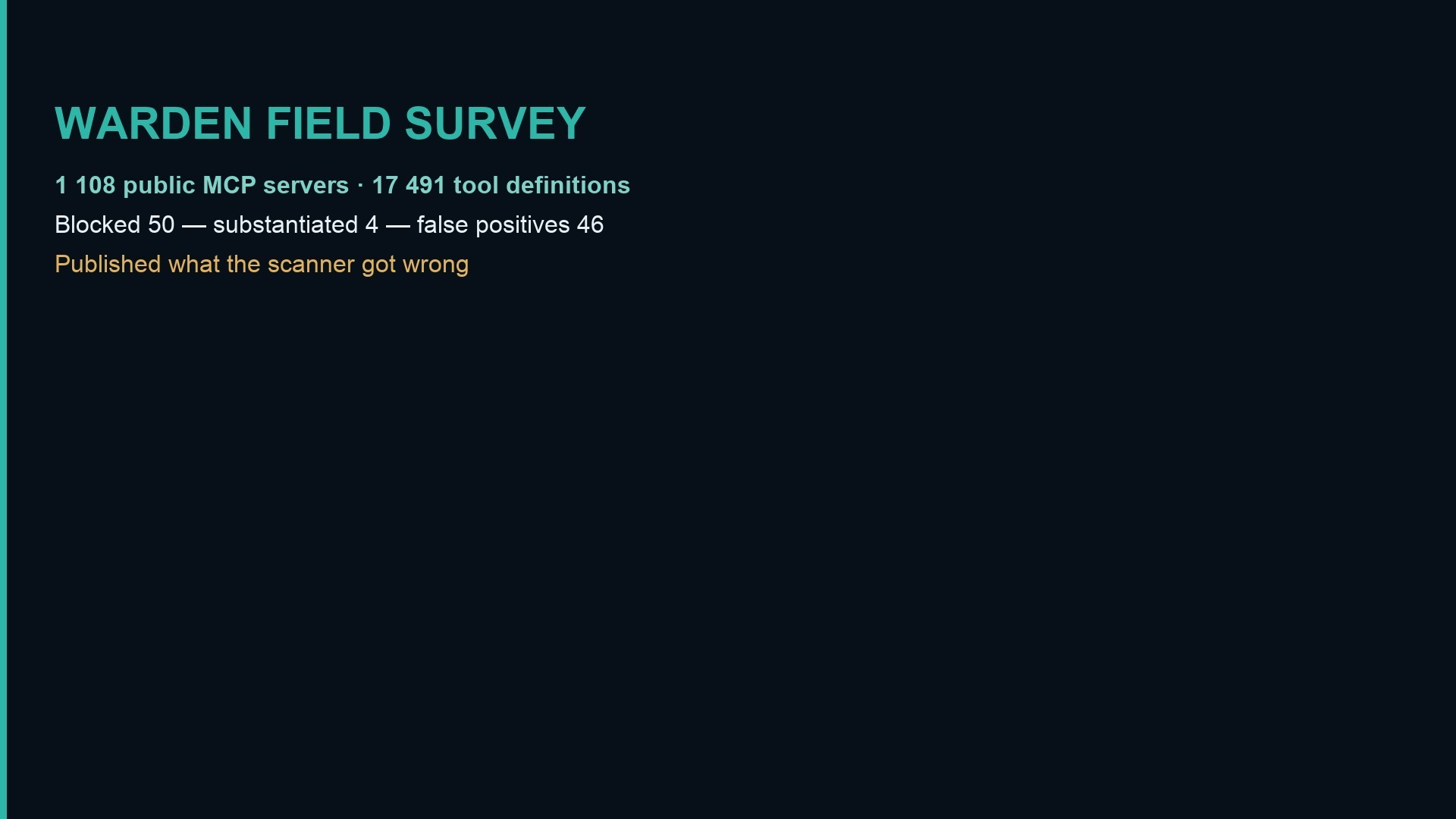
We scanned 1,108 public MCP servers. WARDEN blocked 50 — only 4 were real.
Your MCP server tells the agent what its tools do. The agent believes it.
That sentence is the attack surface — and it is also why nobody knows how dirty the public registry actually is. So we measured it.
Hours after shipping @aimarket/warden 0.3.0, we pointed our MCP security firewall at every public server we could legitimately reach in the official registry. No third-party code was executed. Every tool definition came from the server's own tools/list answer.
Full survey (methods, limitations, JSON corpus): github.com/alexar76/warden/blob/main/docs/mcp-survey.md
Landing: warden.modelmarket.dev
The registry is mostly unreachable
| Step | Count |
|---|---|
| Registry rows fetched | 8 000 |
| Unique servers | 3 121 |
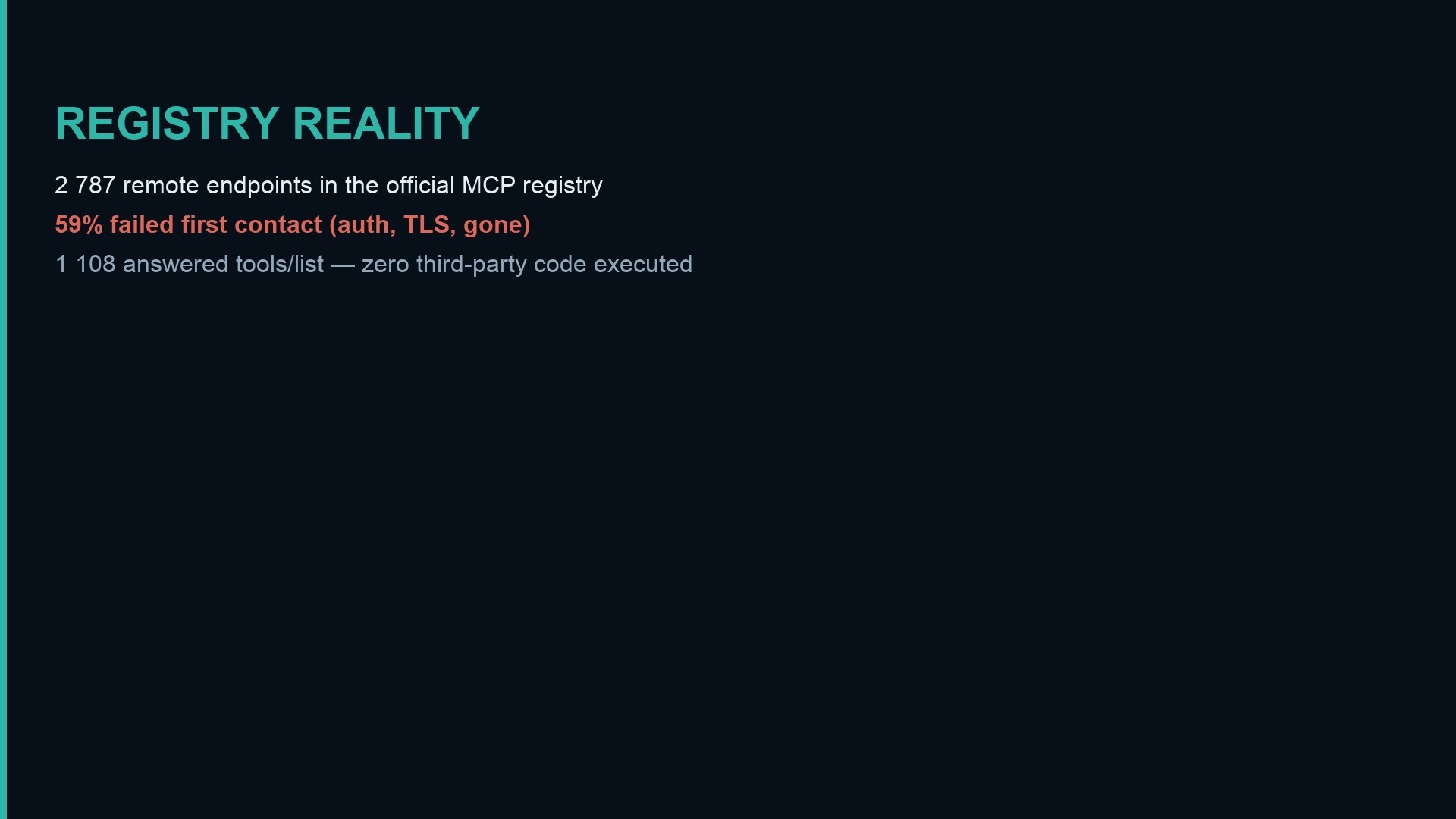
| With a remote endpoint | 2 787 |
Answered tools/list |
1 149 (41%) |
| With at least one tool | 1 108 |
| Tool definitions collected | 17 491 |
If you are building an MCP client against the public registry, plan for 59% first-contact failure — auth walls, TLS errors, gone hosts, protocol mismatches.
We used streamable-http only (20 s timeout, one attempt). Thirty-seven sse servers were skipped. Every stdio server in the awesome-lists is out of scope: reaching those means downloading and running a stranger's code.
WARDEN blocked 50 servers. Four were substantiated.
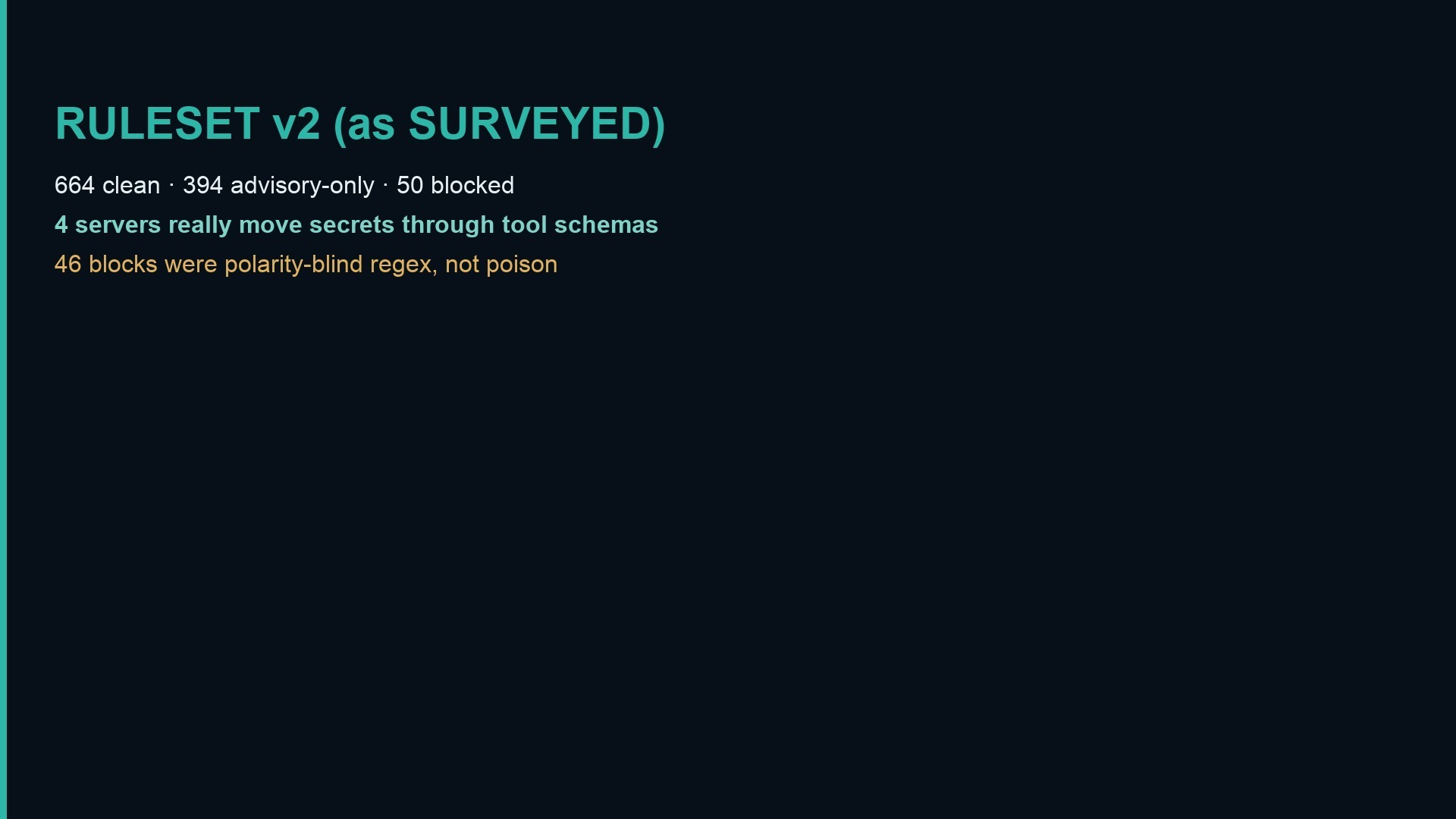
| Servers | Findings | |
|---|---|---|
| scanned | 1 108 | 3 964 |
| clean | 664 | — |
| advisory only (allowed) | 394 | 3 472 |
| blocked | 50 | 492 blocking |
Four of the fifty blocks describe tools that really do move secret material through the model's context — without naming them:
- A treasury tool whose schema takes
signer_private_key("signer EOA private key, 0x…"). - An agent-payments tool that "return[s] its private key exactly once" through the tool channel.
- An identity tool whose prose tells the model to read
credentials.jsonand write JWKprivate_keyfiles. - A managed-database tool with a documented
pvkPasswordparameter.
That is 4 of 1 108 scanned. Everything below is the other 46 — our scanner being wrong.
We are publishing the failures because a tool-poisoning scanner that refuses honest servers is not cautious; it is a scanner that gets uninstalled.
Polarity blindness — our biggest defect
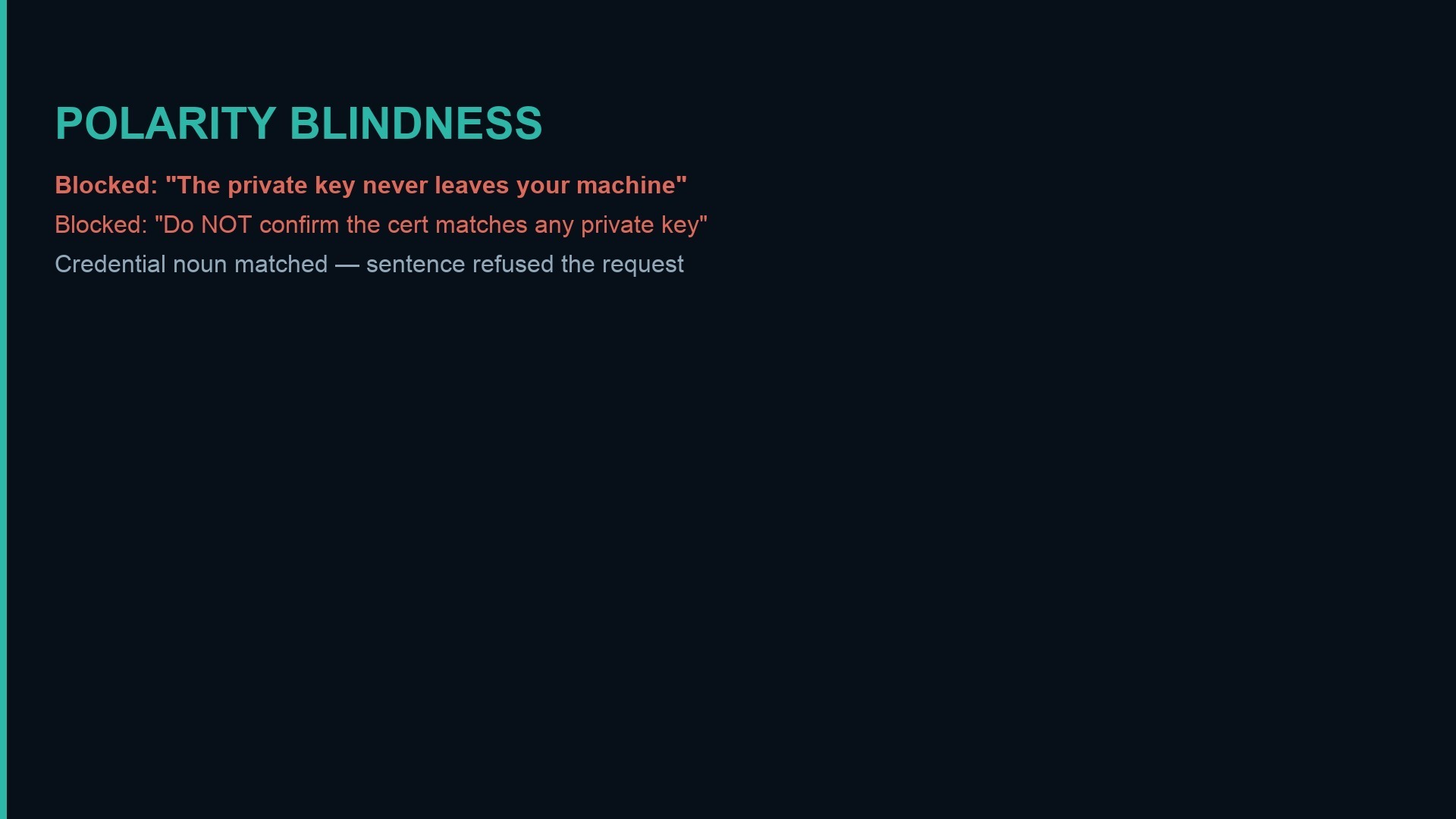
TOOL_DEF_SECRET_REQUEST matched the noun phrase private key. It did not read the sentence around it.
These were all blocked at critical — the whole server refused:
Never send a private key: none is needed and the request is refused if one is present.
— a DANE/TLSA record generatorUse this to import your own public key so you can SSH into instances. The private key never leaves your machine.
— a cloud instance manager…does NOT confirm the certificate matches any private key.
— a certificate inspector
One boilerplate line repeated across 377 tools on a single server counted as 377 findings. We count by server, not by copy-paste.
Other false-positive families from the same corpus:
javascript:in examples — image-API documentation, not an XSS payload.system promptas domain vocabulary — security tools describing the attack surface.- Persian ZERO WIDTH NON-JOINER — required orthography, flagged as "hidden Unicode".
- Threat-feed wildcards —
fundsinside refunds,draininside an anti-drainer scanner.
The advisory tier worked as designed: 3 472 advisory hits blocked nothing. Under ruleset v1, many of those would have refused honest servers outright.
Ruleset v4 — re-measured on the same 1 108 servers
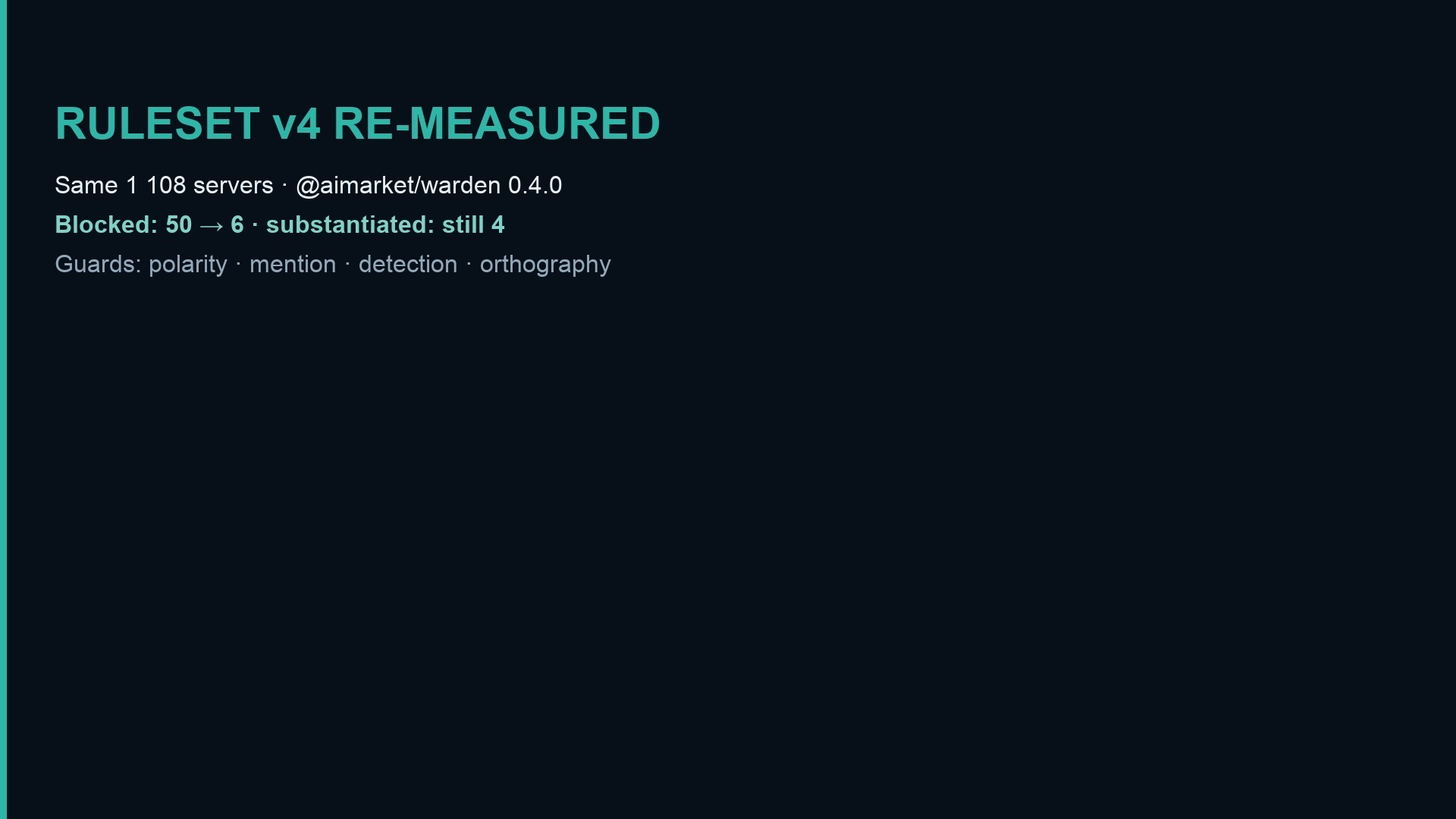
We shipped guards — context checks that decide whether a regex match is the thing the rule is looking for (polarity, mention, detection, uri, zeroWidth, …). Ruleset v4 is in @aimarket/warden 0.4.0.
| ruleset v2 (surveyed) | ruleset v4 | |
|---|---|---|
| servers blocked | 50 | 6 |
| substantiated | 4 | 4 |
| blocking findings | 492 | 12 |
Every real finding still blocks. The regression suite is built from this corpus's actual text — nobody inventing fixtures writes "the private key never leaves your machine" or spells Persian with U+200C.
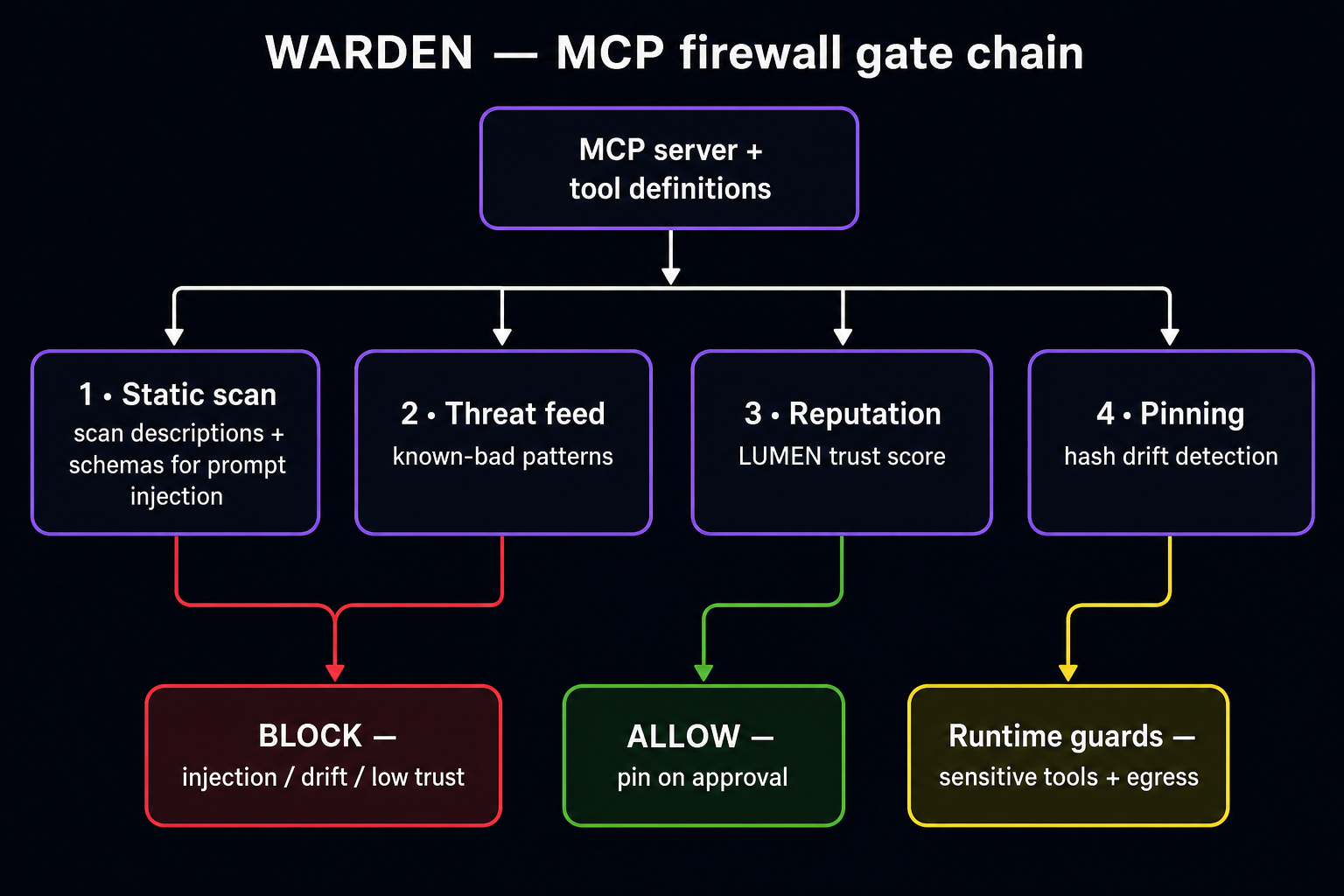
npm install @aimarket/warden
import { Warden, ThreatFeed, silentLogger } from "@aimarket/warden";

const warden = Warden.create({
  policy: { blockAtSeverity: "high", allowUnknownServers: false, pinToolDefs: true },
  threatFeed: new ThreatFeed({}),
  store: { getPin: async () => null, putPin: async () => {} },
  log: silentLogger(),
});

const verdict = await warden.vet(serverRef, tools);
if (!verdict.allow) throw new Error(`blocked: ${verdict.decidedBy}`);
vet() performs no network I/O except an optional signed threat-feed fetch you explicitly load. Zero runtime dependencies beyond node:crypto.
Honest limits
- Definitions, not implementations. A tool whose prose is clean can still exfiltrate on invoke. Static scanning cannot see that.
- No ground truth labels. We can say 46 of 50 blocks were wrong; we cannot count false negatives.
- Auth-gated servers absent. 1 215 servers refused without credentials — the corpus skews open/hobby.
- One snapshot. 2026-08-24. Pinning exists precisely because descriptions rotate later.
Reproduce: scripts/mcp-survey/ · aggregate JSON in docs/data/mcp-survey-2026-08-24.json
Links
- Repo: github.com/alexar76/warden (MIT)
- npm:
@aimarket/warden - Survey write-up: docs/mcp-survey.md
- Earlier Dev.to piece on the firewall itself: Your MCP server might be a prompt injection attack
If you run MCP tools from the public registry, vet the definitions before they reach your model. And if you build a scanner, publish your false positives — that number decides whether anyone turns it on.