On 28 July 2026 MCP dropped its handshake. The 2026-07-28 revision removes initialize, has every request carry its own protocol version, and adds server/discover, which servers must implement to say which versions they speak. A client written for the new revision can talk to a server without opening a session first.
Whether it can actually do that depends on the server on the other end. We know of two earlier counts of protocol versions. Censys scanned internet-exposed MCP services in April 2026: 12,520 services, 89.4% of them on 2025-03-26. That predates the new revision, and it counts whatever answers on an IP address, not what developers install from a registry. The other is our own: on 2 November, as a by-product of fixing a reader that had stopped falling back to the handshake, we published a first figure for remote servers, 4,097 of 21,474, or 19%.
HISTOR, the log we run, reads the tool list of every server in the official MCP registry that it can reach without credentials, and it records the protocol revision each read was answered in. This article repeats the remote count 25 days later, adds the npm and PyPI packages, and looks for what separates the servers that moved from the ones that did not: 51,299 servers in all, four months after the release.
How a read decides
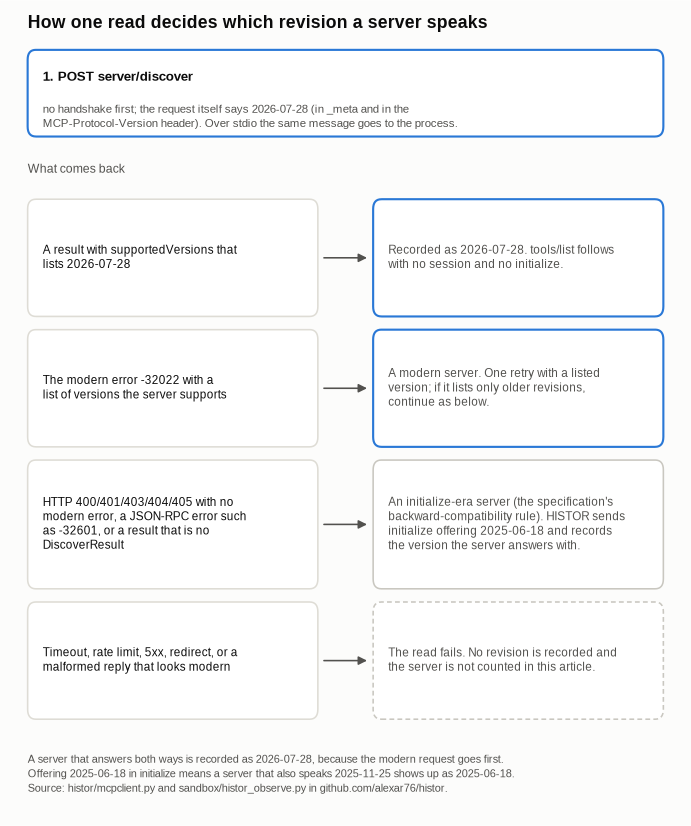
HISTOR sends the modern request first. Over HTTP that is a server/discover call with the version in _meta and in the MCP-Protocol-Version header; for an npm or PyPI package, the same message goes to the process running in a sandbox. A server that answers with a supportedVersions list naming 2026-07-28 is recorded as 2026-07-28. A server that answers the way the specification's backward-compatibility rule describes for older servers gets the old handshake, and HISTOR records the version it negotiates.
You can send the same probe yourself (curl and jq, any recent version):
probe() {
  curl -s "$1" \
    -H 'Content-Type: application/json' \
    -H 'Accept: application/json, text/event-stream' \
    -H 'MCP-Protocol-Version: 2026-07-28' \
    -H 'Mcp-Method: server/discover' \
    -d '{"jsonrpc":"2.0","id":0,"method":"server/discover","params":{"_meta":{"io.modelcontextprotocol/protocolVersion":"2026-07-28","io.modelcontextprotocol/clientCapabilities":{}}}}'
}
probe https://huggingface.co/mcp | jq -c '.result.supportedVersions'
probe https://modelmarket.dev/mcp | jq -c '.result.supportedVersions'
["2026-07-28"]
["2026-07-28","2025-06-18","2025-03-26","2024-11-05"]
Output as of 26 November 2026, 20:00 UTC. The second server is our own marketplace endpoint. When this article went out at 16:37 UTC it answered {"code":-32601,"message":"Method not found: server/discover"}, which is what a handshake-only server says and what the majority described below still says. We moved it the same evening; see the update under "Movement, and our own servers".
The count
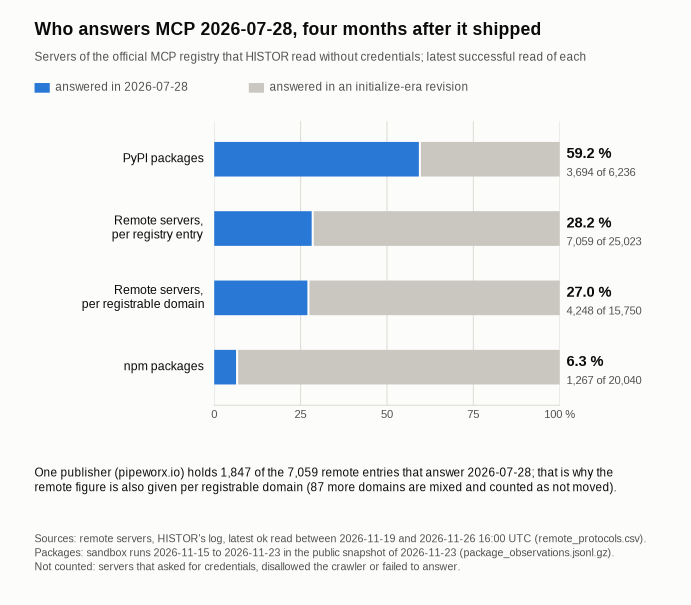
| Revision | Remote servers | PyPI packages | npm packages |
|---|---|---|---|
| 2026-07-28 | 7,059 (28.2%) | 3,694 (59.2%) | 1,267 (6.3%) |
| 2025-11-25 | 127 (0.5%) | 6 (0.1%) | 15 (0.1%) |
| 2025-06-18 | 14,223 (56.8%) | 2,364 (37.9%) | 17,812 (88.9%) |
| 2025-03-26 | 2,986 (11.9%) | 19 (0.3%) | 50 (0.2%) |
| 2024-11-05 | 614 (2.5%) | 153 (2.5%) | 896 (4.5%) |
| other or none recorded | 14 | 0 | 0 |
| Servers | 25,023 | 6,236 | 20,040 |
Each server is counted once, by the revision of its latest successful read. Remote servers: reads between 19 and 26 November 2026, 16:00 UTC. Packages: sandbox runs between 15 and 23 November, the version the registry listed at the time, installed fresh. Servers that asked for credentials, disallowed the crawler or failed to answer are not in the table.
Two things about reading it. HISTOR offers 2025-06-18 in the old handshake, so a server that also speaks 2025-11-25 shows up as 2025-06-18; the 2025-11-25 row only holds servers that answered with it anyway. And the first revision, 2024-11-05, is still what 1,663 servers answer, two years on.
Registry entries are not publishers. Three hosts hold 5,334 of the 25,023 remote entries, about one in five: one Cloudflare Workers host with 2,365 entries, all on 2025-03-26 (most of that row), one publisher's domain with 1,847, all on 2026-07-28, and one host with 1,122, all on 2025-06-18. Counted per registrable domain by the Public Suffix List, 4,248 of 15,750 domains answer 2026-07-28 on every entry (27.0%), 87 are mixed, and 11,415 (72.5%) answer an older revision on every entry. Here the two ways of counting agree. They do not always: in October one publisher's 2,341 near-identical entries turned "a third" into "45%" in our own count of servers that had changed their tool list, and we had to correct it.
One dependency line
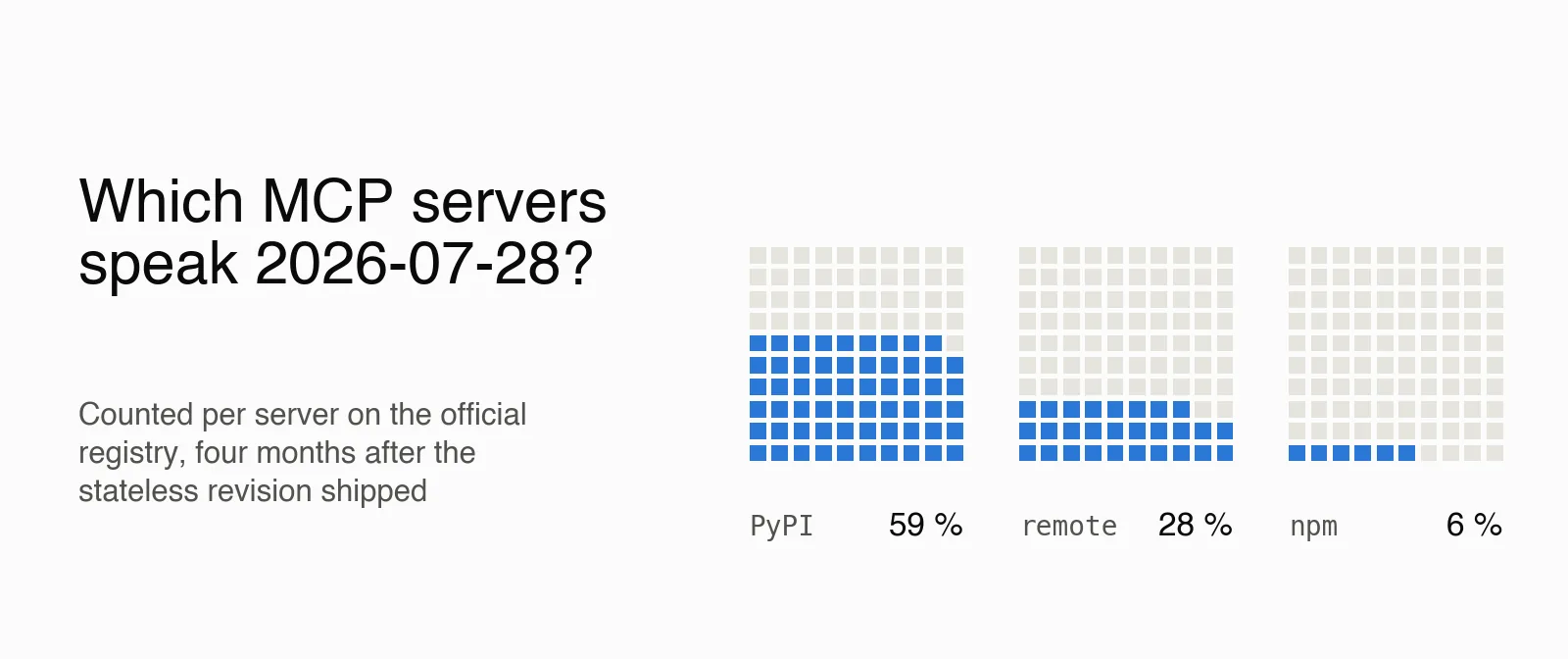
Remote servers do not say what they are built with, but packages do, and the package numbers are too far apart to be about developer enthusiasm: 59% on PyPI, 6% on npm.
The official SDKs explain it. On PyPI the new revision arrived in mcp 2.0.0, uploaded on 28 July 2026 under the same package name; the 1.x line (1.30.0 is the latest) stops at 2025-11-25. FastMCP 4.0.0 followed on 31 August and requires mcp 2.x, while FastMCP 2 and 3 cap it below 2. On npm, @modelcontextprotocol/sdk is still on 1.x (1.32.2, 23 October), and neither its type definitions nor its server module mention 2026-07-28 or server/discover. The new revision ships under new names, @modelcontextprotocol/server, client and core, at 2.x.
So a Python package that declares mcp>=1.2 gets the new SDK the next time someone installs it, and an npm package that declares "@modelcontextprotocol/sdk": "^1.12.0" never will, because no version of that package speaks the new revision. To check that this is what separates the two columns, we drew 300 packages at random from each registry and read the dependency line of the exact version that had run:
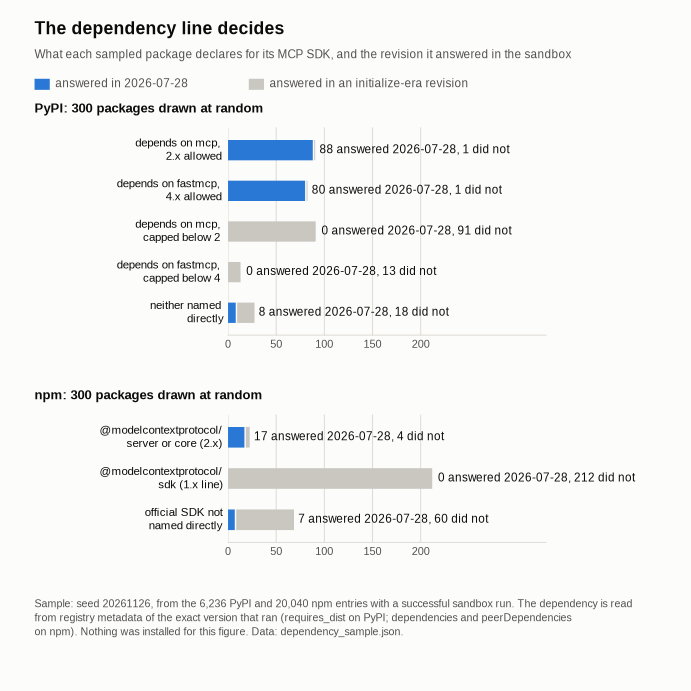
Of the 170 PyPI packages whose dependency line lets the new SDK in, 168 answered 2026-07-28. Of the 104 that cap it, none did. On npm, all 212 packages that depend on @modelcontextprotocol/sdk answered an older revision, and 17 of the 21 that had moved to the new package names answered the new one.
The part we did not expect: 63 of the 176 sampled PyPI packages that answer the new revision ran a version uploaded before 28 July. One of them has a single release, from November 2025, and declares fastmcp>=2.8.0. Nobody has published it since, and a fresh install of it today answers a protocol revision that did not exist when it was written. More than a third of the sampled PyPI servers that moved did so without a release.
That cuts both ways. Those servers picked up a major SDK version with no one testing them against it, and they still started and returned a tool list in our sandbox; the ones that did not start are not in this table. And the 59% is what a fresh install gives. A user with a lockfile or an old virtual environment keeps the SDK they had.
Movement, and our own servers
On 1 November the remote count was 4,097 of 21,474 entries (19.1%). It is 7,059 of 25,023 now (28.2%), and most of that rise is one publisher: its 1,882 entries all answered 2025-06-18 then, and 1,847 answer 2026-07-28 now. Leaving that publisher out of both counts, the share went from 20.9% to 22.5%. Counted per registrable domain it went from 24.2% (3,121 of 12,911) to 27.0%. The 1 November files are public.
The log also shows who switched. Between 2 and 26 November, 2,167 remote servers went from an older revision to 2026-07-28 and stayed there. 1,848 of them are one publisher, on 12 November. The other 319 are spread over 221 domains, about 13 servers a day against 23,000. 109 servers went the other way; HISTOR falls back to the old handshake when a server/discover call fails, so some of those are a failed probe on a server that answers both ways, and we cannot tell which.
When this count was taken, one of our own eleven readable registry entries answered 2026-07-28: the HISTOR package on PyPI. The hub endpoint, the four tool endpoints, three PyPI packages and the Attested Memory hub answered 2025-06-18, and WARDEN, which has no SDK dependency and implements the protocol itself, answered 2025-03-26.
Update, 26 November, 20:00 UTC. We moved them after publishing. The six remote endpoints have answered 2026-07-28 since between 19:48 and 19:54 UTC and still accept the initialize handshake; a client of either era gets the same tool list. The hub and the tools service implement the protocol by hand, and there the rules of the new revision came to one module each (188 lines of Python, 127 of JavaScript): decide per request which era it belongs to (a protocol version in the body's _meta, or the method server/discover), check the MCP-Protocol-Version, Mcp-Method and Mcp-Name headers against the body, and answer in plain JSON with no session. The three PyPI packages are ported from FastMCP to the 2.x SDK's MCPServer; their tool lists, compared over stdio against the 1.x build, are byte-identical. WARDEN's stdio server got the same change. Those four switched for registry users when the new versions went out: aimarket-mcp 0.7.0, aimarket-oracle-gateway 0.4.0 and aimarket-mcp-packager 2.2.0 on PyPI on the evening of 26 November, @aimarket/warden 0.40.0 on npm on 27 November, 05:06 UTC. Since then all eleven entries answer 2026-07-28. The counts in this article are the 26 November snapshot and include none of this.
If you ship a server or a client
Client authors: keep the handshake. 72.5% of the remote domains we could read answer nothing else. Sending server/discover first and falling back, as the specification describes, costs one round trip on those.
Python authors: look at your dependency line, because it has already decided for you.
curl -s https://pypi.org/pypi/mcp-server-fetch/json \
  | jq -r '.info.requires_dist[] | select(test("^(mcp|fastmcp)"))'
mcp<3,>=2.3
That is the reference fetch server, which requires 2.x outright. If yours says mcp>=1.x with no upper bound, your users are already on 2.x whenever they install fresh, so test against it. If it says mcp<2, you are pinned to the handshake until you lift the cap.
npm authors: nothing changes until you change the import. A caret range on @modelcontextprotocol/sdk cannot reach the new revision. The reference filesystem server shows the move:
curl -s https://registry.npmjs.org/@modelcontextprotocol/server-filesystem/latest \
  | jq -c '.dependencies | with_entries(select(.key | startswith("@modelcontextprotocol/")))'
{"@modelcontextprotocol/node":"^2.1.1","@modelcontextprotocol/server":"^2.3.1"}
Both outputs as of 26 November 2026.
Recount it
The package half comes from a public snapshot. The remote half is one row per server exported from HISTOR's database with the query in remote_protocols.sql. Python 3.9 or newer, standard library only; the downloads are about 60 MB:
B=https://modelmarket.dev/blog/which-mcp-servers-speak-2026-07-28-59-of-pypi-packages-28-of-remotes-6-of-npm
S=https://histor.modelmarket.dev/datasets/2026-11-23
for u in $B/count_protocols.py $B/psl.py $B/remote_protocols.csv \
         $S/package_observations.jsonl.gz $S/servers.jsonl.gz \
         https://publicsuffix.org/list/public_suffix_list.dat; do
  curl -fsSLO --retry 3 "$u"
done
python3 count_protocols.py remote_protocols.csv package_observations.jsonl.gz \
  servers.jsonl.gz public_suffix_list.dat > results.json
python3 -c "import json; r = json.load(open('results.json')); print(r['remote']['byVersion']['2026-07-28'], r['packages']['byRegistryType']['pypi']['2026-07-28'], r['packages']['byRegistryType']['npm']['2026-07-28'])"
{'n': 7059, 'pct': 28.21} {'n': 3694, 'pct': 59.24} {'n': 1267, 'pct': 6.32}
Our output is results-2026-11-26.json. The dependency sample is dependency_sample.json, 600 rows with package, version, declared dependency and revision, made by sample_dependencies.py with seed 20261126; it reads registry metadata and installs nothing. The Public Suffix List changes, so a later copy can move the domain figures by a few.
What the count does not cover
- Only servers HISTOR could read without credentials. A server behind a login is not here, and those may differ.
- One reader, one vantage point, one week for remotes and eight days for packages.
- A server that answers both ways is counted as 2026-07-28, because the modern request goes first. HISTOR does not store the version list a server advertises, so this count cannot say how many of the servers that moved still accept the old handshake.
- The package figures describe a fresh install of the registry's listed version in our sandbox. They are not a count of what is running on developers' machines.
- The dependency sample is 300 packages per registry. It supports the explanation; it is not a census of dependency lines.
- The remote domain view treats everything under one registrable domain as one publisher. A hosting platform that is not on the Public Suffix List would be merged into one.
We run HISTOR and build WARDEN. AI assistance was used for the count, the code, the figures and this article.